Your Customers Already Said It Better. Introducing ProofQL.
By Platte Gruber, founder of root.
I built a tool to make my dental clients’ websites better. Then I realized it shouldn’t be just for them.
Imagine you’re looking for a new dentist.
You’re nervous about an upcoming root canal, so you find a practice and open its website. The homepage has a handful of five-star reviews. “Great staff!” “Wonderful office!” “Highly recommend!”
That’s nice. But it’s not what you came looking for.
What you really want to know is whether the dentist is gentle. Whether the procedure hurts. Whether someone like you walked in scared and left feeling relieved.
Somewhere in that practice’s 200 Google reviews, a patient might have answered those exact questions.
You’ll probably never find it.
That’s the problem I built ProofQL to solve.
Reviews aren’t decoration. They’re answers.
Most websites treat customer reviews as something to sprinkle around for credibility.
A few testimonials on the homepage. Maybe a rotating carousel. Occasionally a dedicated reviews page that nobody visits.
But reviews are much more useful than that.
A parent considering pediatric dentistry wants to hear from other parents. Someone looking at dental implants wants to hear about the implant experience. A nervous patient wants to know whether the dentist made someone else feel comfortable.
The same principle applies outside dentistry.
Someone considering a home renovation wants to know whether the contractor showed up on time. Someone booking a wedding photographer wants to know how they handled a stressful day.
The most convincing review isn’t necessarily your highest-rated one. It’s the one that answers the question your visitor has right now.
And you probably already have it.
It’s just buried somewhere in your reviews.
So I built ProofQL.
ProofQL is a tool for finding the right customer reviews and showing them in the right places.
You bring your existing reviews. ProofQL searches them by meaning, not just exact keywords, and finds the ones most relevant to what someone is looking for.
For example, suppose a patient writes:
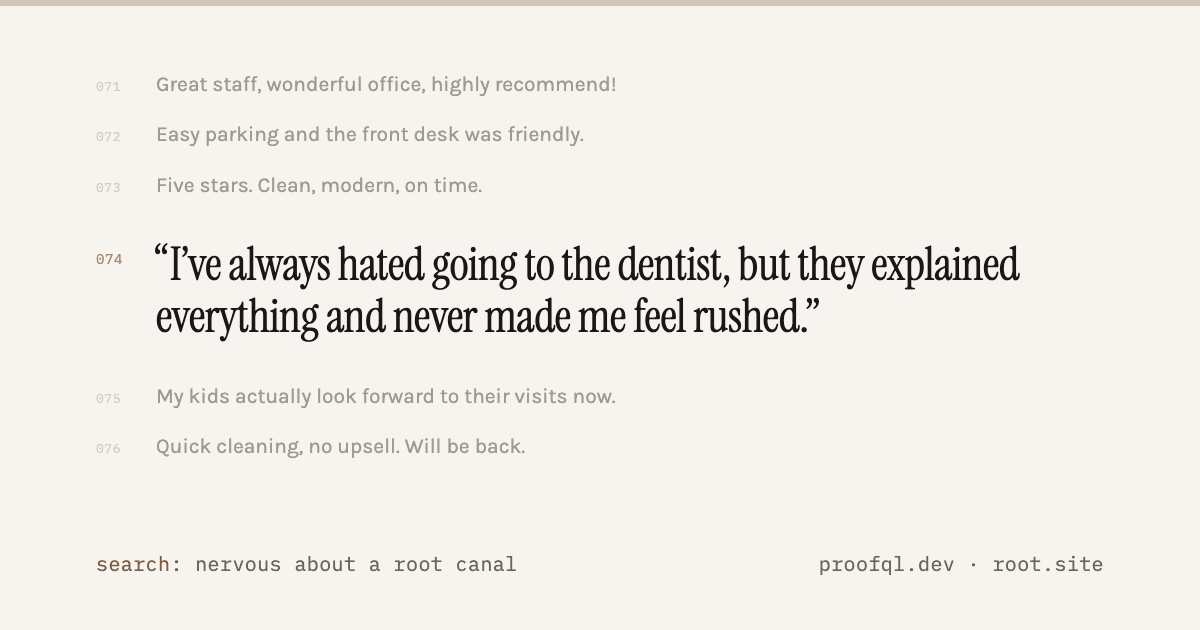
I’ve always hated going to the dentist, but they explained everything and never made me feel rushed.
That review might be especially useful on a page about helping anxious patients, even though it never uses the words “dental anxiety.”
ProofQL can make that connection.
And here’s an important part: it doesn’t rewrite the review.
The words are still your customer’s words. No AI-generated testimonials. No polished-up quotes that sound suspiciously like your own marketing copy.
Just real people describing real experiences, matched to the places where those experiences matter.
Developers can use ProofQL’s API or a lightweight website widget to display the results. You can customize how they appear without manually selecting a different set of testimonials for every page.
It’s a relatively simple idea. I was surprised how much work it took to make it happen.
This was supposed to be a root thing.
I run root, a small web agency that builds and maintains websites for independent dental practices.
My job is to make those websites genuinely useful, not just attractive.
And I kept coming back to reviews.
Dental practices work hard to earn them. Patients take time out of their day to write them. Some of those reviews contain incredibly specific, helpful things that a new patient would love to know.
Then we take all that valuable information and put five generic testimonials on the homepage.
It felt like a waste.
Originally, ProofQL was going to be something I offered my root customers. A little extra I could build into their websites that the average dental agency wasn’t providing.
But as I worked on it, something became pretty obvious.
This isn’t a dental website problem.
It’s an every website with customer reviews problem.
Why should someone need to hire me to use the solution?
So I’m opening it up.
ProofQL is now its own project at proofql.dev.
You don’t need to be a root customer. You don’t need to run a dental practice. If you build websites and have customer reviews worth showing, I want you to be able to use it.
And I’m making it as free as I reasonably can.
There are real costs behind running a service like this, so I can’t promise unlimited usage at no cost forever. But I want the free tier to be genuinely useful, not a glorified trial that stops working the moment you do something interesting.
I didn’t start building ProofQL because I saw a giant untapped software market.
I started building it because I wanted a feature for my customers, couldn’t find quite what I wanted, and decided to make it myself.
Now that it exists, keeping it locked inside my own agency seems silly.
If other developers can make better websites with it, great.
If a small business gets more value from reviews it already earned, even better.
And if people start using it in ways I never considered, that’s probably the most exciting outcome of all.
Give it a try.
If you build or maintain websites, I’d love for you to try ProofQL.
Import some reviews. Search for something specific. See whether the results surprise you.
You might discover that the perfect testimonial for one of your pages has been sitting unnoticed in your Google reviews for years.
And if it doesn’t work the way you’d expect, tell me. I’m building this myself, and feedback from people actually trying to use it is worth more than a hundred feature ideas I come up with on my own.
I started building this to make a handful of dental websites better.
I’d be pretty happy if it ended up making a lot more websites better, too.
— Platte